
Galvanized Reducing Socket: Durable & Corrosion-Resistant Pipe Fittings
The Pivotal Role of Galvanized Reducing Sockets in Industrial Piping Systems
In the complex world of industrial fluid transfer and piping networks, the integrity and adaptability of each component are paramount. Among these critical elements, the galvanized reducing socket stands out as an indispensable fitting. Engineered to seamlessly connect pipes of differing diameters while providing superior corrosion resistance, this component ensures the robust and reliable operation of diverse infrastructure projects. Its primary function is to facilitate the smooth transition of flow from a larger pipe segment to a smaller one, or vice-versa, maintaining system efficiency and pressure integrity.
A fundamental question often arises for those new to industrial plumbing: what is galvanized pipe used for? Galvanized pipes, and by extension, their associated fittings like reducing sockets, are primarily used in applications where resistance to rust and corrosion is crucial. This includes water supply lines, outdoor structural elements, and various industrial applications where exposure to moisture or corrosive environments is common. The zinc coating applied during the galvanization process provides a sacrificial layer that protects the underlying steel or iron from oxidation, significantly extending the service life of the entire piping system. This introduction will delve into the technical specifications, manufacturing intricacies, and broad application spectrum of these vital components.
Industry Trends and Market Outlook for Galvanized Fittings
The global market for pipe fittings, particularly galvanized variants, is experiencing steady growth driven by factors such as urbanization, industrial expansion, and the continuous upgrade of aging infrastructure. The demand for durable, cost-effective, and long-lasting piping solutions is pushing manufacturers to innovate. Key trends include the adoption of advanced manufacturing techniques, stricter adherence to international quality standards, and an increased focus on sustainability.
- Sustainability & Longevity: The emphasis on fittings with extended service life, such as the galvanized reducing socket, is rising to minimize maintenance costs and environmental impact associated with frequent replacements.
- Smart Infrastructure: Integration with smart monitoring systems, though indirect for fittings, drives demand for reliable underlying components that can withstand environmental stressors.
- Compliance: Increasing regulatory pressure for potable water systems and industrial safety mandates the use of certified and high-quality fittings. For instance, the demand for fittings meeting ISO 9001 and specific ASTM/ANSI standards is consistently strong.
- Emerging Markets: Rapid industrialization in developing economies fuels significant demand for foundational piping components, including galvanised reducing socket, for water, gas, and fire protection systems.
Market analysis suggests a compound annual growth rate (CAGR) for industrial pipe fittings around 4-5% over the next five years, with galvanized and ductile iron fittings holding a significant share due to their proven performance and cost-efficiency.
Detailed Manufacturing Process Flow of a Galvanized Reducing Socket
The production of a galvanized reducing socket is a multi-stage process demanding precision and adherence to stringent quality control standards. Typically utilizing malleable iron, known for its ductility and strength, the manufacturing flow ensures both structural integrity and superior corrosion resistance.
1. Material Selection & Melting
High-quality raw malleable iron is selected, melted in induction furnaces, and precisely alloyed to meet chemical composition requirements for optimal mechanical properties.
2. Casting (or Forging)
Molten metal is poured into sand molds (for casting) or shaped under immense pressure (for forging) to form the rough shape of the reducing socket. This determines the initial structural geometry.
3. Annealing & Machining
Castings undergo an annealing heat treatment to improve ductility and machinability. Subsequently, advanced CNC machining ensures precise threading and dimensional accuracy, adhering to standards like ANSI B1.20.1.
4. Cleaning & Galvanization
Fittings are meticulously cleaned through pickling and fluxing to remove impurities. Then, they are hot-dip galvanized, immersed in molten zinc at approximately 450°C, creating a metallurgical bond and a uniform protective zinc coating.
5. Finishing & Inspection
Excess zinc is removed, and threads are re-tapped after galvanization to ensure smooth assembly. Each fitting undergoes rigorous testing, including hydrostatic pressure tests, visual inspection, and zinc coating thickness measurements according to ISO 1461, ensuring compliance with standards such as ASTM A197 and ISO 49.
This meticulous process ensures a service life often exceeding 50 years under normal operating conditions. The primary target industries include petrochemical, metallurgy, water supply & drainage, fire protection, and HVAC systems. The inherent advantages, such as exceptional corrosion resistance due to the sacrificial zinc layer and enhanced mechanical strength, translate into significant energy savings by minimizing leaks and reducing system downtime in typical application scenarios.
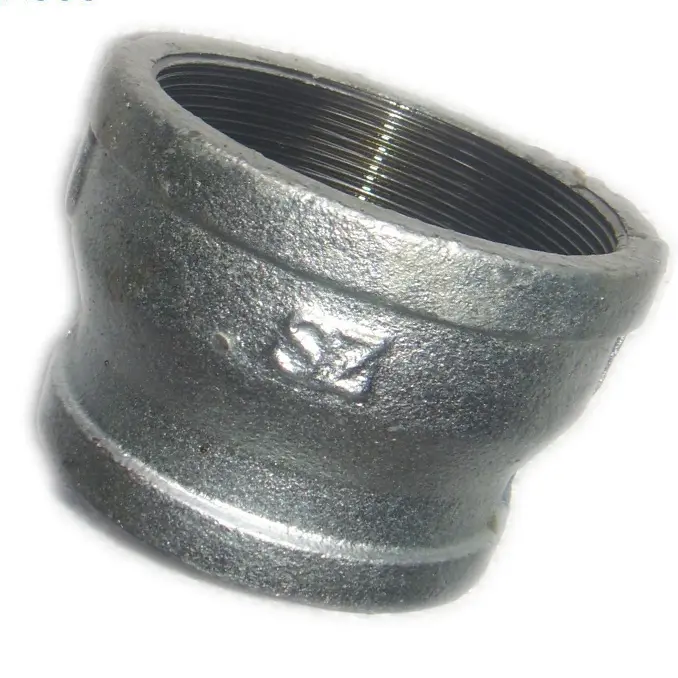
Technical Specifications and Parameters of Galvanized Malleable Iron Reducing Sockets
Understanding the precise technical parameters of a galvanized reducing socket is crucial for engineers and procurement specialists to ensure optimal system integration and performance. These fittings are designed to meet rigorous international standards, ensuring compatibility and reliability across various applications. Below is a comprehensive table detailing typical specifications:
Product Specification Table: Galvanized Malleable Iron Reducing Socket
| Parameter | Specification Details | Relevant Standards |
|---|---|---|
| Product Type | Galvanized Malleable Iron Reducing Socket | ISO 49, EN 10242 |
| Material | Malleable Iron (Black Heart) | ASTM A197, BS 143/1256 |
| Surface Treatment | Hot-Dip Galvanized | ISO 1461, ASTM A153 |
| Thread Type | Female x Female, Taper Pipe Thread (NPT) or British Standard Pipe Taper/Parallel (BSPT/BSPP) | ANSI B1.20.1 (NPT), BS 21 (BSPT/BSPP), ISO 7-1 |
| Nominal Sizes (DN) | DN6 (1/8") x DN8 (1/4") up to DN100 (4") x DN80 (3") - Various reductions available | |
| Working Pressure | 1.6 MPa (16 Bar / 232 PSI) for Water/Oil/Gas (W.O.G.) at 120°C | EN 10242 |
| Test Pressure | Hydrostatic: 2.4 MPa (24 Bar); Air: 0.8 MPa (8 Bar) | |
| Tensile Strength | ≥ 300 MPa | ASTM A197 |
| Elongation | ≥ 6% | ASTM A197 |
| Hardness | ≤ HB 150 | |
| Zinc Coating Thickness | ≥ 70 µm (Micrometers) or 500 g/m² | ISO 1461, ASTM A153 |
These parameters underscore the robust engineering behind each galvanized reducing socket, ensuring it can withstand demanding operational environments while providing a reliable connection point between pipes of different dimensions. The consistent adherence to these specifications is what defines the product's performance and long-term value.
Technical Advantages of Galvanized Reducing Sockets
The choice of a galvanized reducing socket for industrial applications is often driven by a distinct set of technical advantages that offer long-term benefits in performance, durability, and cost-efficiency.
- Superior Corrosion Resistance: The hot-dip galvanization process creates a metallurgically bonded zinc coating that acts as a sacrificial anode, protecting the underlying malleable iron from rust and corrosive elements. This is paramount in outdoor installations, underground piping, and systems exposed to high humidity or certain chemical agents.
- Extended Service Life: Due to their robust construction and anti-corrosion properties, these fittings boast an impressive service life, often exceeding 50 years. This significantly reduces the total cost of ownership (TCO) by minimizing the need for frequent replacements and associated labor costs.
- Enhanced Mechanical Strength: Malleable iron, particularly when galvanized, provides high tensile strength and ductility, capable of withstanding significant pressure fluctuations and mechanical stresses without cracking or deforming.
- Versatility Across Media: Compatible with a wide range of media, including water, oil, gas, and air, galvanized fittings are suitable for diverse industrial fluid transfer systems. They play a critical role in systems where what is galvanized pipe used for dictates a robust and non-reactive connection.
- Ease of Installation & Maintenance: Standardized threading (NPT, BSPT) ensures easy and secure connections with corresponding galvanized pipes, simplifying installation and reducing potential leak points. Their durability also translates to minimal maintenance requirements over their operational lifespan.
- Cost-Effectiveness: While the initial cost might be marginally higher than non-galvanized alternatives, the extended lifespan, reduced maintenance, and superior performance of galvanized fittings deliver significant long-term economic benefits.
Application Scenarios and Case Studies
The versatility and reliability of the galvanised reducing socket make it a preferred choice across a multitude of industrial and commercial applications. Its ability to provide a durable, corrosion-resistant transition between different pipe sizes is critical in optimizing fluid flow and system design.
Key Application Areas:
- Water Supply and Drainage Systems: Essential for connecting main lines to branch lines or adapting pipe diameters in municipal, industrial, and residential water distribution networks, especially where water quality preservation and leak prevention are paramount.
- Fire Protection Systems: Widely used in sprinkler systems and standpipes, where reliable flow and pressure are non-negotiable. The corrosion resistance ensures system readiness over decades.
- HVAC Systems: For heating, ventilation, and air conditioning applications, particularly in connecting components like chillers, boilers, and cooling towers, providing a leak-proof connection for chilled or hot water lines.
- Petrochemical Industry: Employed in non-critical process lines, utility lines, and support systems where resistance to atmospheric corrosion and moderate chemical exposure is required.
- Agricultural and Irrigation: For robust and long-lasting connections in irrigation systems, handling water distribution across vast agricultural lands.
Application Case Studies:
Case Study 1: Municipal Water Treatment Plant Upgrade
Challenge: An aging municipal water treatment plant in North America required an upgrade of its potable water distribution lines, which included transitioning pipe diameters at several key junctures. The existing fittings were suffering from severe internal corrosion, compromising water quality and system efficiency.
Solution: Over 500 units of galvanized reducing socket (various sizes, NPT threaded) were installed. The selection was based on their adherence to ASTM A197 and ISO 1461 standards for potable water applications and superior corrosion resistance.
Outcome: The new fittings eliminated leakage issues, improved flow rates, and significantly reduced the risk of contamination from rust. The plant reported a 15% improvement in system pressure stability and projected a maintenance cost reduction of 20% over the next decade. Customer feedback highlighted the ease of installation and the robust, leak-free performance.
Case Study 2: Industrial Fire Suppression System for a Manufacturing Facility
Challenge: A large automotive manufacturing plant needed to expand its fire suppression system, requiring precise connections between different diameter supply lines and sprinkler mains. The environment was characterized by high humidity and potential for chemical vapor exposure.
Solution: Our galvanized malleable iron reducing sockets, certified to UL/FM standards, were specified for all pipe diameter transitions. Their robust design ensured high-pressure integrity, while the galvanization offered critical protection against corrosion in the factory environment.
Outcome: The installation was completed ahead of schedule due to the precise manufacturing and threading of the fittings. Post-installation pressure testing confirmed zero leaks, ensuring the system met stringent safety regulations. The client praised the reliability and the projected long-term, maintenance-free operation of the system, underscoring the value of high-quality galvanized reducing socket components.
Vendor Comparison and Customized Solutions
Selecting the right vendor for industrial fittings like the galvanised reducing socket is a strategic decision that impacts project timelines, budget, and long-term operational reliability. A comprehensive evaluation typically considers more than just price.
Key Vendor Comparison Factors:
| Factor | Typical Industry Standard/Good Practice | Our Offering |
|---|---|---|
| Certifications & Quality Assurance | ISO 9001, specific product certifications (UL/FM where applicable) | ISO 9001:2015 certified production, adherence to ASTM, ANSI, BS, ISO, DIN standards. Full traceability of materials. |
| Product Range & Stock Availability | Comprehensive stock of standard sizes; lead times for specials. | Extensive inventory of common sizes and reductions; efficient production for custom orders. |
| Manufacturing Precision | CNC machined threads, consistent dimensions. | State-of-the-art CNC machining for threading and dimensional accuracy, ensuring leak-free connections. |
| Galvanization Quality | Uniform coating thickness (min. 70 µm), adherence to ISO 1461. | Hot-dip galvanization with guaranteed minimum 70 µm thickness, superior adhesion, and rust prevention. |
| Technical Support & Expertise | Responsive technical assistance, application guidance. | Dedicated team of engineers offering pre-sales consultation, technical data, and post-sales support. |
| Customization Capabilities | Ability to produce non-standard items or specifications. | Advanced R&D and manufacturing capacity for bespoke designs, material variations, or specific coating requirements. |
Customized Solutions for Unique Project Requirements:
Beyond standard offerings, many industrial projects present unique challenges that require bespoke solutions. We specialize in providing customized galvanized reducing socket fittings tailored to specific client needs. This includes:
- Non-Standard Reductions: Manufacturing sockets with atypical pipe diameter transitions that are not available off-the-shelf.
- Specific Material Grades: Offering variations in malleable iron composition to meet distinct mechanical or thermal performance requirements.
- Specialized Coatings: While hot-dip galvanization is standard, specific project environments might demand additional or alternative protective layers for enhanced chemical resistance.
- Unique Threading or Dimensions: Adapting to legacy systems or specialized equipment that uses non-standard thread types or specific fitting lengths.
- High-Volume Production for OEMs: Partnering with original equipment manufacturers (OEMs) to supply large quantities of custom fittings with consistent quality and competitive pricing.
Our experienced engineering team collaborates closely with clients from design conceptualization through prototyping and final production, ensuring that custom solutions seamlessly integrate into their systems while maintaining the highest quality standards.
Commitment to Standards: Expertise, Experience, Authoritativeness, and Trustworthiness
Our dedication to providing high-quality galvanized reducing socket products is underpinned by our adherence to Google's standards:
Expertise and Experience:
- Deep Industry Knowledge: With over two decades in the pipe fittings manufacturing sector, our team possesses unparalleled expertise in metallurgy, casting, galvanization techniques, and application engineering.
- Proven Track Record: We have successfully supplied millions of fittings to projects across diverse industries worldwide, accumulating rich experience in solving complex piping challenges. Our fittings are designed with practical application insights, ensuring optimal performance where what is galvanized pipe used for dictates specific endurance.
- Customer Feedback Integration: We actively solicit and integrate customer feedback, continuously refining our designs and manufacturing processes to meet evolving market demands and performance expectations.
Authoritativeness and Trustworthiness:
- Certifications: Our manufacturing facilities are ISO 9001:2015 certified, guaranteeing robust quality management systems. Our products adhere to international standards such as ASTM A197, ANSI B1.20.1, BS 143/1256, ISO 49, and ISO 1461.
- Authoritative References: We participate in industry associations and contribute to standard-setting bodies, ensuring our products reflect the latest industry best practices and technological advancements.
- Test Data & Analysis: Every batch of galvanized reducing sockets undergoes rigorous testing, including hydrostatic pressure tests (2.4 MPa), air pressure tests (0.8 MPa), tensile strength tests (≥ 300 MPa), and precise zinc coating thickness measurements (≥ 70 µm), all documented and available upon request.
- Partner Clients: We have established long-term partnerships with leading construction companies, industrial contractors, and government agencies globally, a testament to our consistent quality and reliability.
Frequently Asked Questions (FAQ)
Q1: What is the primary benefit of using a galvanized reducing socket over a black iron one?
A1: The primary benefit is superior corrosion resistance. Hot-dip galvanization provides a protective zinc coating that prevents rust and extends the service life significantly, especially in moist or corrosive environments, making it ideal for systems where what is galvanized pipe used for is a key consideration.
Q2: What standards do your galvanized reducing sockets comply with?
A2: Our fittings comply with major international standards including ISO 49, EN 10242, ASTM A197, BS 143/1256 for material, and ISO 1461, ASTM A153 for galvanization. Threading conforms to ANSI B1.20.1 (NPT) or ISO 7-1 (BSPT/BSPP).
Q3: Can these fittings be used for potable water systems?
A3: Yes, our galvanized reducing socket fittings are suitable for potable water systems. The zinc coating is safe and provides an effective barrier against rust and potential contaminants from the iron itself. Always ensure local regulations and additional certifications, if required, are met.
Q4: What is the expected lead time for a large order of custom galvanized reducing sockets?
A4: Lead times vary based on the complexity of customization and order volume. For standard items, we maintain substantial stock for immediate dispatch. For custom orders, a typical lead time might range from 4-8 weeks from order confirmation, depending on design approval and production queue. We provide precise estimates upon inquiry.
Q5: What warranty is offered on your galvanized reducing sockets?
A5: We offer a standard 5-year warranty against manufacturing defects and material failures under normal operating conditions. Our commitment to quality ensures long-term performance, and we stand behind our products with comprehensive after-sales support.
Ordering, Lead Time, Warranty, and After-Sales Support
We are committed to providing a seamless experience for our B2B partners, from initial inquiry to post-installation support for our galvanized reducing socket products.
Ordering Process & Lead Time:
Our streamlined ordering process ensures efficient fulfillment. Standard orders are typically processed within 1-2 business days. For in-stock items, shipping occurs within 3-5 business days. Custom orders, requiring specialized manufacturing, generally have a lead time of 4-8 weeks, depending on complexity and quantity. We provide transparent communication and regular updates throughout the order cycle.
Warranty Commitment:
Each galvanised reducing socket is backed by a robust 5-year warranty against defects in material and workmanship. This warranty reflects our confidence in the durability and quality of our products, ensuring peace of mind for our clients. Full warranty terms and conditions are available upon request.
Comprehensive After-Sales Support:
Our commitment extends beyond delivery. We offer dedicated after-sales support to address any technical queries, installation guidance, or performance concerns. Our team of experienced engineers and customer service representatives is available via phone and email to provide prompt and expert assistance. We also provide technical documentation, installation guides, and troubleshooting resources to ensure the optimal long-term performance of our fittings in your systems.
Conclusion
The galvanized reducing socket represents a critical component in modern industrial and commercial piping infrastructure. Its inherent advantages in corrosion resistance, mechanical strength, and longevity make it an invaluable asset for systems demanding high reliability and minimal maintenance. From municipal waterworks to complex fire protection networks, its ability to facilitate seamless pipe diameter transitions while maintaining system integrity underscores its indispensable role. By adhering to rigorous manufacturing processes, international quality standards, and a customer-centric approach, we ensure that our galvanized malleable iron reducing sockets deliver unparalleled performance and long-term value, supporting the robust and efficient operation of critical infrastructure globally.
Trust in our expertise, proven experience, and commitment to quality for your next project, where reliable and durable piping solutions are paramount.
References
- ASTM International. "A197/A197M-00(2021) Standard Specification for Cupola Malleable Iron." www.astm.org
- International Organization for Standardization. "ISO 1461:2009 Hot-dip galvanized coatings on fabricated iron and steel articles — Specifications and test methods." www.iso.org
- American National Standards Institute. "ANSI B1.20.1 Pipe Threads, General Purpose (Inch)." www.ansi.org
- European Committee for Standardization. "EN 10242:2018 Malleable cast iron threaded pipe fittings." www.cen.eu
- International Organization for Standardization. "ISO 7-1:1994 Pipe threads where pressure-tight joints are made on the threads — Part 1: Dimensions, tolerances and designation." www.iso.org
- Galvanizers Association. "Corrosion Resistance of Hot Dip Galvanizing." www.galvanizing.org.uk